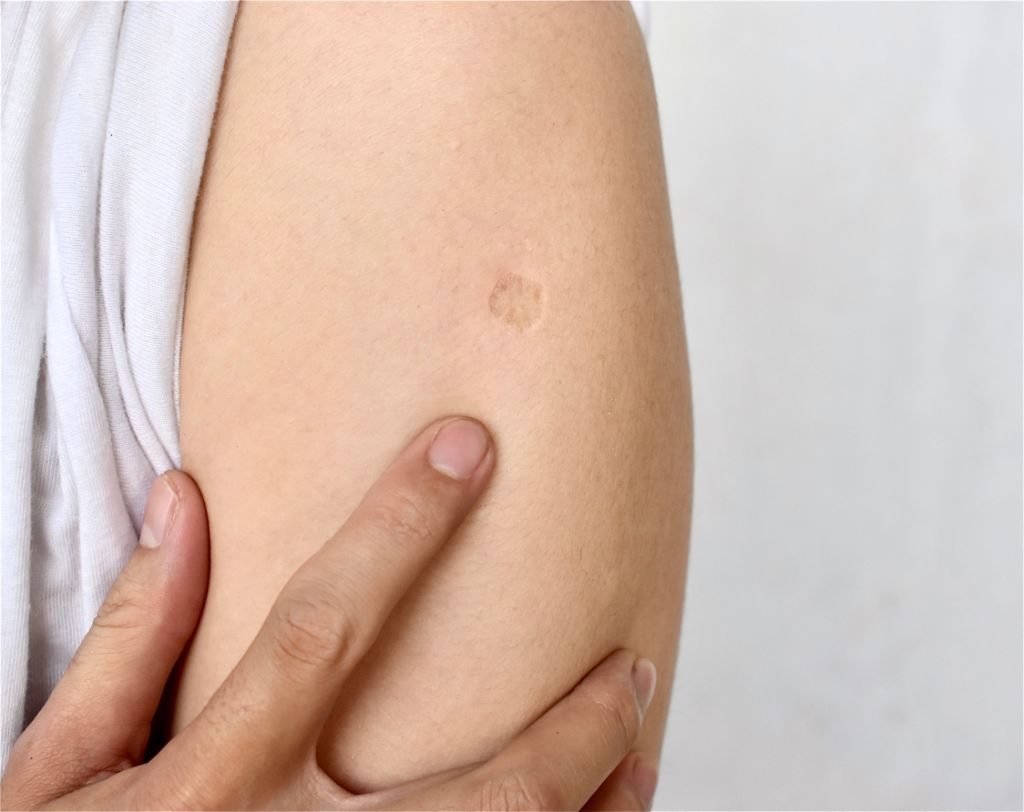
If you grew up in Asia, Africa, Latin America, or parts of Eastern Europe, there’s a strong chance you have a small, round scar on your upper arm. It’s usually about the size of a coin. Slightly indented. Sometimes darker than the surrounding skin.

Many people only notice it years later—while changing clothes, swimming, or seeing old photos. And almost inevitably, the question comes up:
“Where did this come from?”
For some, the scar becomes a source of embarrassment. Others are teased about it. Some invent explanations—an old injury, a childhood illness, a burn—because no one ever explained the truth.
That small scar has carried decades of confusion, stigma, and misinformation.
Below are five of the most common misconceptions about the round scar on the arm—and the deeper truth behind each one.
Misconception 1: “It’s a skin disease or a childhood injury”
This is one of the most common beliefs. Many people assume the scar is the result of a skin infection, a boil, chickenpox complications, or an injury they don’t remember clearly. Some even believe it came from a burn, a cut, or an untreated wound that healed badly.
The deeper truth: In most cases, the round scar is caused by the BCG vaccine, which was designed to protect against tuberculosis (TB)—a disease that once killed millions worldwide.
The vaccine is typically given in infancy or early childhood. Because it happens so early in life, most people have no memory of the injection or the healing process. Over time, the event disappears from memory, but the mark remains.
Importantly, the scar is intentional—not accidental. It forms because the vaccine is given just under the skin rather than deep into the muscle. This method triggers a localized immune reaction, which sometimes results in a small ulcer that later heals into a scar.
Nothing went wrong. The body did exactly what it was supposed to do.

Misconception 2: “Only people from poor or rural backgrounds have it”
This belief is often rooted in social prejudice. In some cultures, the scar has been unfairly associated with poverty, rural living, or “backward” healthcare systems. People with the scar may feel judged or labeled because of it.
The deeper truth: The BCG vaccine was introduced as part of national public health programs, not because families were poor—but because tuberculosis was widespread and dangerous.
At different points in history, countries across Europe, Asia, Africa, and Latin America vaccinated entire generations of children, regardless of class, education, or income. Wealthy families, urban families, and government officials’ children received the same vaccine.
The presence of the scar reflects public health priorities of a specific era, not personal background. It says nothing about hygiene, intelligence, or social status.
Misconception 3: “If you don’t have the scar, you weren’t vaccinated”
People often compare arms with siblings or friends and assume the scar is definitive proof of vaccination. This leads to confusion and arguments, especially within families.
The deeper truth: Not everyone who receives the BCG vaccine develops a visible scar.
Scar formation depends on several factors:
- Individual immune response
- Skin type and healing patterns
- Injection technique
- Age at vaccination
- Aftercare and environmental exposure
Some people heal with barely any mark at all. Others develop a clear scar that fades significantly over decades.
So:
- No scar ≠ no vaccine
- Scar ≠ stronger immunity
Medical records—not scars—are the only reliable confirmation.

Misconception 4: “The scar means your immune system is weak or damaged”
This misconception can cause real anxiety. Some people worry that the scar indicates a defect in their immune system or long-term vulnerability to illness.
The deeper truth: The BCG scar is actually a sign of a normal and healthy immune response.
When the vaccine is introduced, the immune system recognizes the weakened bacteria and mounts a localized defense. That response may involve redness, swelling, and eventually a small lesion that heals into a scar.
In recent decades, researchers have even explored how early vaccines like BCG may help “train” the immune system to respond more effectively to other infections later in life.
The scar is not damage. It is evidence of immune activity—not weakness.
Misconception 5: “It’s dangerous or should be removed”
Because the scar is visible and sometimes textured, some people fear it might become harmful, grow over time, or need medical removal.
The deeper truth: The BCG scar is completely harmless.
It does not spread.
It does not turn into cancer.
It does not indicate disease.
Doctors consider it a benign, permanent mark, similar to a healed childhood scar. There is no medical reason to remove it unless someone chooses cosmetic treatment for personal reasons.
From a health perspective, it requires no attention at all.

Why No One Explained It
For many families, especially in past decades, vaccination was routine and unquestioned. Parents were told, “Bring your child.” They complied. There was little discussion, no long explanations, and no follow-up conversations years later.
Children grew up protected—but uninformed.
As healthcare systems modernized, the explanations improved, but the silence surrounding this scar lingered. Generations carried the mark without the story.
A Small Scar with a Big History
That small round scar is not a flaw.
It is not a disease. It is not a sign of hardship or neglect.
It is a quiet reminder of a time when infectious diseases shaped national policy—and when prevention happened long before understanding.
For millions of people, it represents early protection given without ceremony or explanation.
Sometimes, the smallest marks carry the longest stories.